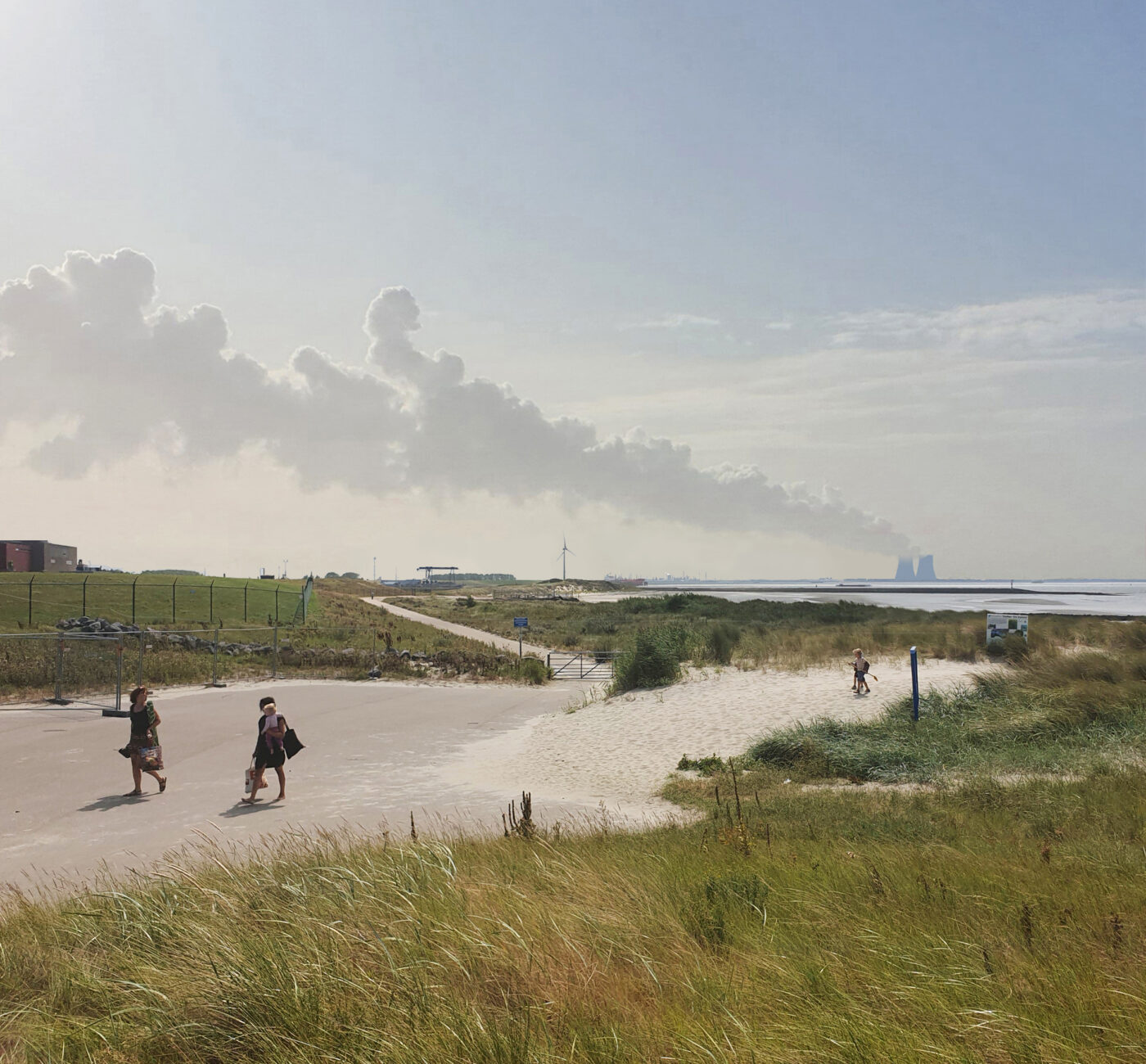
Slowly but surely, the net is closing around the choice of location for a new nuclear power plant in the Netherlands. The locations Borssele and the Maasvlakte were recently dropped, Terneuzen in the province of Zeeland and Eemshaven in Groningen remain on the list. A few more months and it will be one of those two. Not that it matters much to most of us, it seems, but at the borders of our country it counts all the more. The Groningers will invoke a debt of honor because of the problems after gas winning. And the Zeelanders? They are divided.
I like to say that Zeeland is the only province that has become more beautiful in the past fifty years. Every dam, every sea sluice, every wind turbine and every metre of dike elevation – it all contributes to a sense of progress and the awareness that we are ‘little people in a bigger world’. Systematic choices have been made here that have led to a beautiful landscape that shows itself to be powerful and resilient. There is pride in the land that has been reclaimed from the sea and made by human hands.
At the same time, Zeeland is under pressure. The ever-advancing infrastructure is visible, making the province feel increasingly full. More invisible is the threat of rising sea levels and inland waters, which are becoming increasingly unhealthier. On land, salinization is at play. Traditional arable farming is compromised and with it the close bond between the villages and the surrounding farmlands. The experience of the seasons, the yield of diligent labor and the experience of a divine providence that gave their blessing to Zeeland’s existence for centuries are on their last legs.
More recently, the peripheral condition appears to be abused for the construction of national energy facilities. The majority of offshore wind farms (even those way more north along the coast!) come ashore with their cable in Zeeland, our national power strip. Changes are visible in rows of high-voltage pylons, villages with an increasingly older population are becoming more and more emptier. The only constant is the sea, the magnet for tourists. Of them, there are so many in some places and at certain times that it sometimes displaces the people of Zeeland.
And so Zeeland has long managed to maintain the illusion of a vital rural region – small centers surrounded by agricultural emptiness. But the cracks are gradually appearing, like a slow disaster that is taking place in Zeeland. Through a combination of service, modesty and mutual division, the province offers little or no resistance to the destructive changes that present themselves from within and then from outside in Zeeland.
In this interplay of forces, the Zeelanders have to position themselves in the discussion about whether or not to build a new nuclear power plant. After all, the national government follows the salami tactics. The need for cooling towers is unadulterated silence and the Board of Spatial Government Advisors is absent. The question of whether there should be a large nuclear power plant or several smaller ones, closer to the customer, is not included in the consideration. It all has little to do with planning. This is the shadow play of organized irresponsibility.
Zeeland stumbles into a new reality. Whether or not the nuclear power plant at Terneuzen is built, as the discussion is going now, it does not contribute to unity or solidarity. Some see an opportunity to benefit economically. A nuclear power plant will bring jobs and possibly data centers to Zeeland (energy guzzlers wanted!). Or a lucrative deal to finance expensive infrastructure such as a new Zeeland Bridge. Others mainly see the landscape that is affected and the horizon that pollutes further. Zeeland that does what others say. The nuclear power plant as a divisive issue.
Last year, the Spatial Policy Document decentralized spatial to a regional level. That is that scale on which thing are about to happen. On the accompanying map of the Netherlands, flowing figures in all kinds of colors indicate the spatial developments. Zeeland pales in the map. Seen from The Hague, there is apparently little dynamism in this region. That sounds like a ball in front of an open goal. Zeeland, recognize the momentum, seize this opportunity! This is not about an incident, about windfalls or hand-wringing. It is much larger. Spatial planning is a complicated puzzle in a limited space. This can only be done if there is a common picture of where things should go in the province. Therefore, take the lead in grafting the changes, growth and therefore possibly also a nuclear power plant onto the understanding of existing qualities and shared values. A lot can be destroyed, but this can also be the perfect time to come out stronger as a province. With a vision of how all space users together share and strengthen this unique delta. It would turn Zeeland immediately into a leader in regional area development in the Netherlands!
A fundamental subject touches on deeper values. And that is precisely what it should be about. About the natural foundation of soil and water on which the province is built. About Zeeland’s identity and communities that hold things together. About everything that makes Zeeland so beautiful, so special. Then we can continue optimistically.
Henk Hartzema, Linkedin 27 June 2026
Image: Cooling towers in the Paulinapolder near Terneuzen seen from the dune next to the nuclear power plant in Borssele (photomontage).


