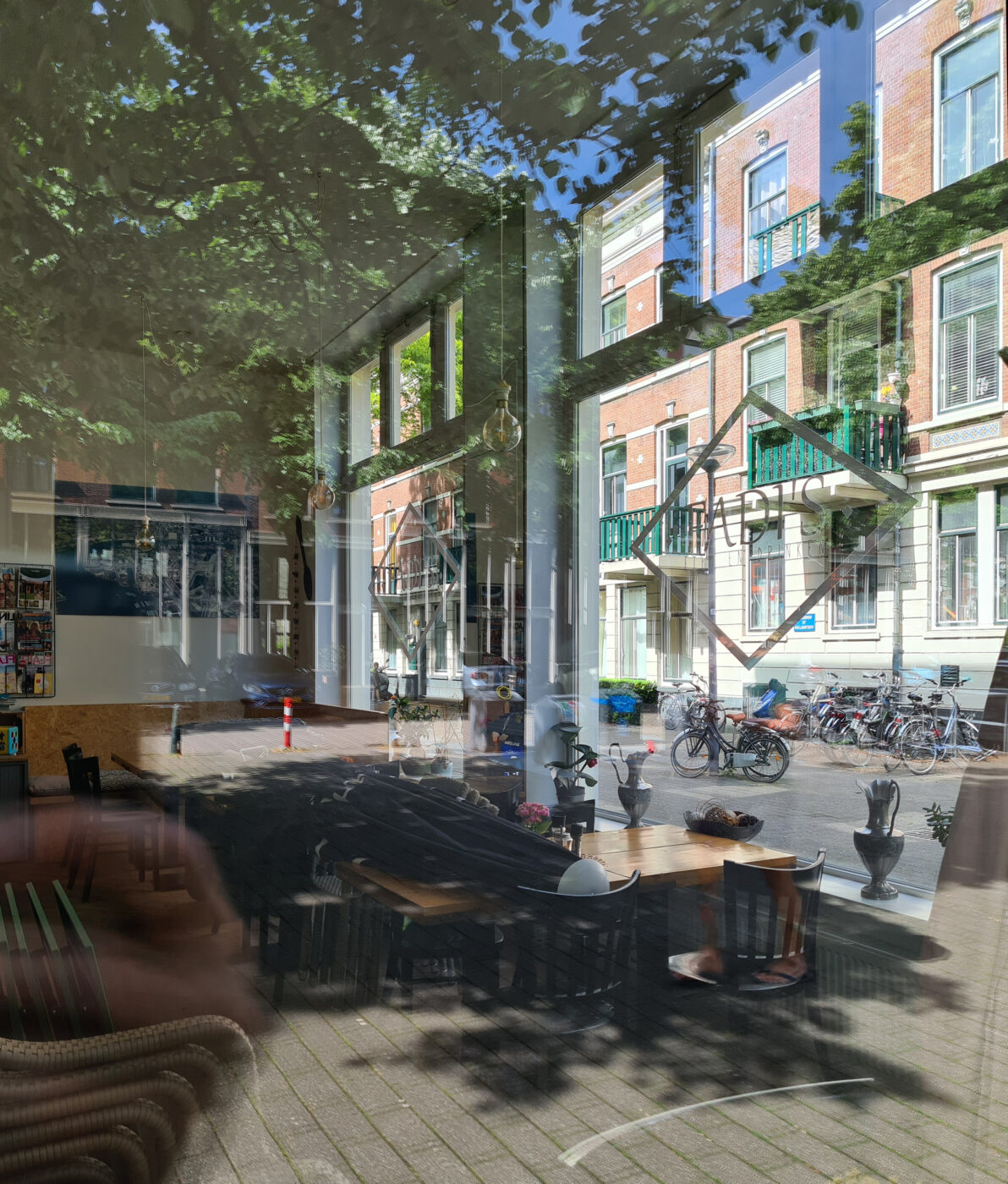
Dutch cities are becoming fuller and more intense, since the many new homes are largely integrated into the existing urban fabric. At the same time, on average, homes are getting smaller. The addition of denser cities and smaller homes means that there is less space available for the average city dweller.
Less and less space for every citizen living in our cities, while the need for meeting and being outside is not decreasing, perhaps even growing due to the shrinking of the average household, risking loneliness and lack of social interaction.
In the footsteps of the Dutch city
Traditionally, the Dutch city has been a layered and egalitarian entity. Refined fabrics of buildings and spaces in which different groups live together and feel protected. Erik de Jong describes in “Hortus Conclusus; the laws of the garden” about the beginning of the Dutch planning tradition, with the explanation of Amsterdam in the 17th century in which the connection between city and garden is recognizable. “City and garden are related to each other in Dutch. The English town and the Dutch ‘tuin’ have a common etymological origin in the Old High Germanic ‘tun’, which means fence. (…) Both garden and city offered protection and seclusion, which means that in the Netherlands we can see a similarity in the streets, squares and courtyards of the city, the intimacy of corridors and rooms in the house and the avenues and enclosed rooms of the garden. In the seventeenth and eighteenth centuries, many foreign visitors saw the Dutch city as an urban landscape. The unity of moat, street, pavement and house was visually extended in thought with the plot behind the house where the yards were located, often provided with a garden from the sixteenth century onwards, or elements thereof such as orchard, bleaching field or parterre.” The Dutch planning tradition has evolved over the centuries, of course, in which seclusion and protection were always cast in a different form of space, appropriate to the way in which the unity of the group was formed.
Urban planning is abolishing itself
It is therefore special and shocking to see that recently our cities are becoming fuller, but our urban planning is becoming increasingly hollow. The course sings away from a tradition of the makeable society in which values such as collectivity, moderation, transparency and order were translated into orchestrated spatial compositions of urbanity, with facilities, forms of housing and landscaping that connect to them. We are now living through an era of a declining field in which the filling of building blocks and a discussion about the most desirable configuration of density seems to be the highest ideal and in which every spatial designer can therefore make urban plans. Without vistas or an idea of where society is heading, urban planning is a soulless show, in which the miracle of the future has been exchanged for the pragmatics of key figures and excel overviews. Interchangeable urban environments are graced with the new dogma of the lively plinths. Urban cohesion based on building lines, coffee shops and terraces. Our former heroes Berlage, Van Lohuizen, Van Eesteren and Verhagen stand by and watch.
Cities are becoming harder, the margins are narrowing, green is the new decorative morality. From the rebound, small enclaves are founded where target groups within a certain housing concept and limited living environment can withdraw from the larger whole. A quiet revolution from an open and future-oriented city to introverted and affirming urban environments.
Pocket places as a gift for the city
In the urban development framework for the Havenkwartier in Rijswijk, pocket spaces are provided; space that is left open by developers on their plots and that benefit the structure of the public space. Places, squares and passages complement the roads, harbour basins and quays. The hypothesis is that these pocket spaces contribute to the well-being of residents and users in this crowded part of the city as a social design.
Quantitative conditions have been created for these pocket places by means of the incentive rule. The incentive rule states that 20% of the plots will not be built on but will be set up as pocket space. The floor area that cannot be realized by creating this pocket space may then be added twice on top of the aforementioned Rijswijk height. By only allowing this on a part of the buildable surface, irregularities arise in the building mass with a legible underlayment.
Home is more than the house
Studio Hartzema / FRESH has conducted spatial research into the meaning of pocket places in the densified city under the title “My home is more than my House”.
A number of preliminary conclusions can be drawn from the research. The first conclusion is that the space form pocket space occurs only to a very limited extent in the recent urban palette. In a way, front rooms are common practice in public buildings such as schools, universities, town halls, etc. In almost all cases, residential buildings are located directly on the street (or are located in the green). The most common green-urban building form is a courtyard. A second conclusion is that, when residential buildings take a certain distance from the street, this space is often considered residual space. Interspersed with insignificant greenery and filled with a logistical overflow of bicycles and containers, any form of dignity or upgrade seems to have disappeared from view. A final conclusion is that when a pocket space does add something to the quality of the building and the place, there is actually a more attractive living environment. In addition, there is an expansion of the residential area. The home is getting bigger than the house itself. The collective outdoor space can be added to the quality of the place. The building does not turn away but reaches out to the street. Conversely, entering the pocket place means postponing the entrance. The residential building distances itself from the street making a representative gesture. Making space where it is scarce adds value.
Henk Hartzema in ‘My home is more than my House’, Spatial research into the meaning of pocket places in the densified city, April 2022


