In the relative calm of the summer of 2025, the Dutch Council of State ruled on the construction plans left and right of the Euromast. For years, objections have been made to the Parkhaven project in Rotterdam. Nothing new, but the municipality in this particular case was sent back to the drawing board.
The Zoning Plan should include better guarantees for a high-quality green design. To prevent damage to the cultural-historical values of the monumental Euromast and to guarantee a park-like setting.
Undoubtedly, this will lead to adjustments so that the objections can be ticked off and the planned 650 homes can be built. No illusions, though. There was the perfect opportunity here to extend the monumental Park to the water and connect it with the surroundings. The unique opportunity to fit in sports and play areas that are under pressure elsewhere. The last opportunity to make Het Park more generous.
Space as trade
Not for the first time that we have lost space that originally belonged to all of us. In the late 80s the so called Window on the River disappeared building the Maritime Museum, Tropicana appeared on the open banks of the river Meuse and a plastic cinema took a large bite out of the city’s central square, Schouwburgplein. More recently, the Museum Park was partly given as a location to the Depot of museum Boijmans Van Beuningen. The considerations are always incidental, never principled. Land as a commodity.
The argument for the Parkhaven project is also that the green space is marginally used and that housing is simply needed.
This way of thinking and the legal fine-tuning that follows obscures the underlying question. Namely, whether inner-city densification, a contemporary mantra, is sufficiently substantiated. Hundreds of thousands of homes within existing cities, 50,000 in Rotterdam, that will work. But what makes a good city? What preconditions are involved, how much greenery and what does that look like? It is unexplored territory, not only in Rotterdam.
Green foundation
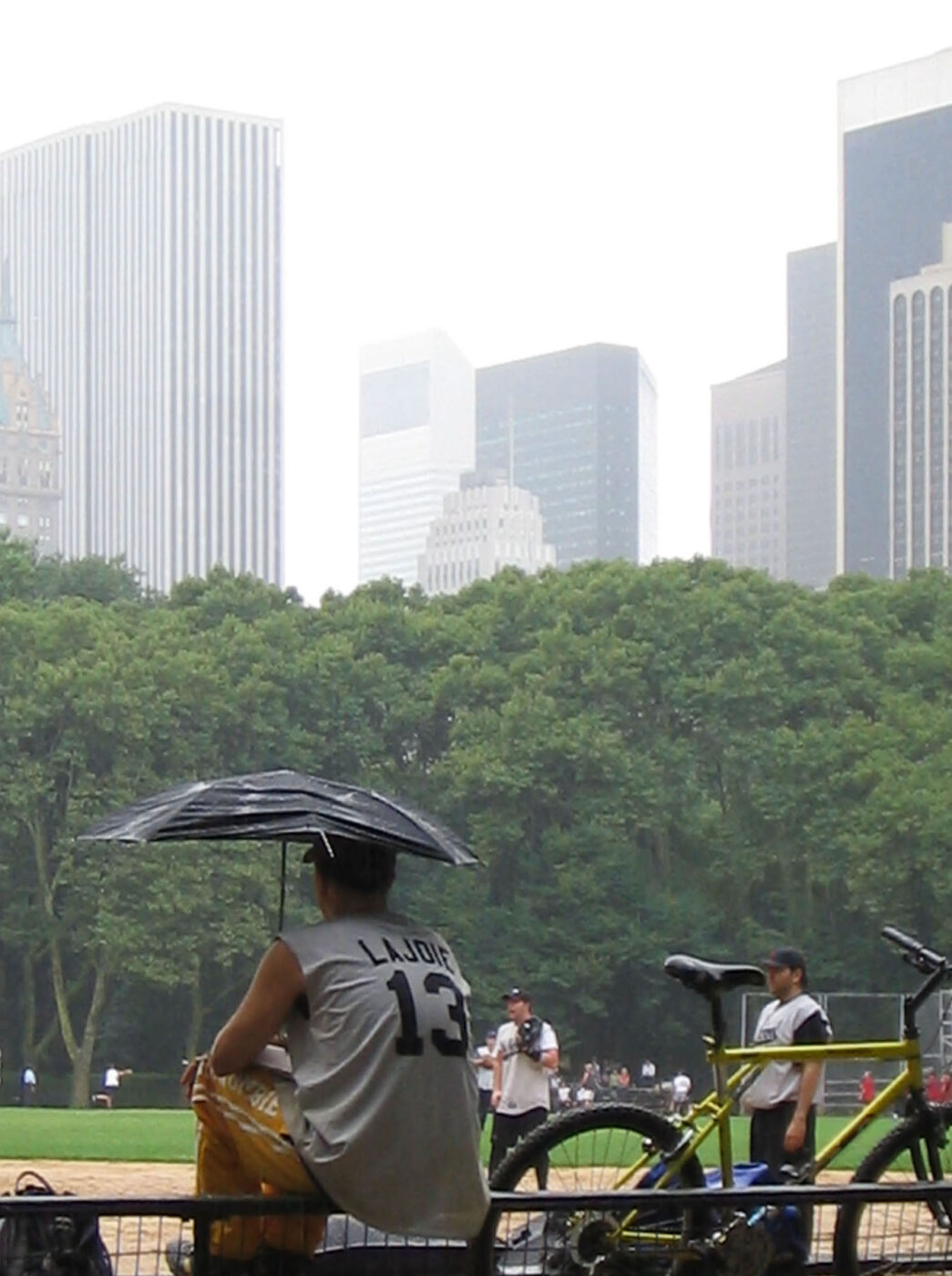
Urban densification is meaningless if it is not accompanied by enlightened choices. In Manhattan, Bowling Green was built in the 17th century. A small public park with seating areas and a large fountain in a meaningful place. A fence marked the value of this space in a well-defined and forever way. Manhattan had a population of 400,000 when the wave of densification started in the middle of the 19th century. Many parks and green structures were laid out at a rapid pace, with Central Park (1859) as the best known and largest. Space for the future was guaranteed here. Now that the city has become four times as full, there is still room for relaxation, meeting and sports (including 20+ baseball fields!). This is where Manhattan escapes itself for a moment.
Now every comparison between the cities is as ridiculous as it is flawed. But allow me. Rotterdam within the highway ring is about the same size as Manhattan and the number of inhabitants is now, at the start of it’s urban densification, coincidentally also around 400,000. Manhattan claimed more than 15% for a green foundation, Rotterdam has only a third of this within the Ring. All incomparable, I know, but still.
Cities that want to densify must radically green before the troops. Not only according to the norms, fragmentary and in accordance with today’s fashion, but grand, coherent and public by its nature. Green care taking is needed instead of the merchant spirit.
Let that be the lesson when the cheese slicer is brought along our beautiful Park on the Meuse. Don’t mess with the foundations of the city!
Henk Hartzema, LinkedIn, 14 September 2025


