Housing shortages, loneliness, aging, diseases and exploding healthcare costs seem to be separate issues, but are closely linked. The right collaborations lead to valuable solutions.
There is plenty of reason to bring the worlds of healthcare and spatial planning together. But how do we do that? How do we create homes, neighbourhoods and villages where the well-being of people and the community is central? It is a question that architect and urban planner Henk Hartzema has been occupying for decades. Caring neighbourhoods where residents flourish may not be as sexy as shiny apartment complexes for expats and other high potentials, but in the end, “the small success of caring for the most vulnerable is the most important thing,” he says.
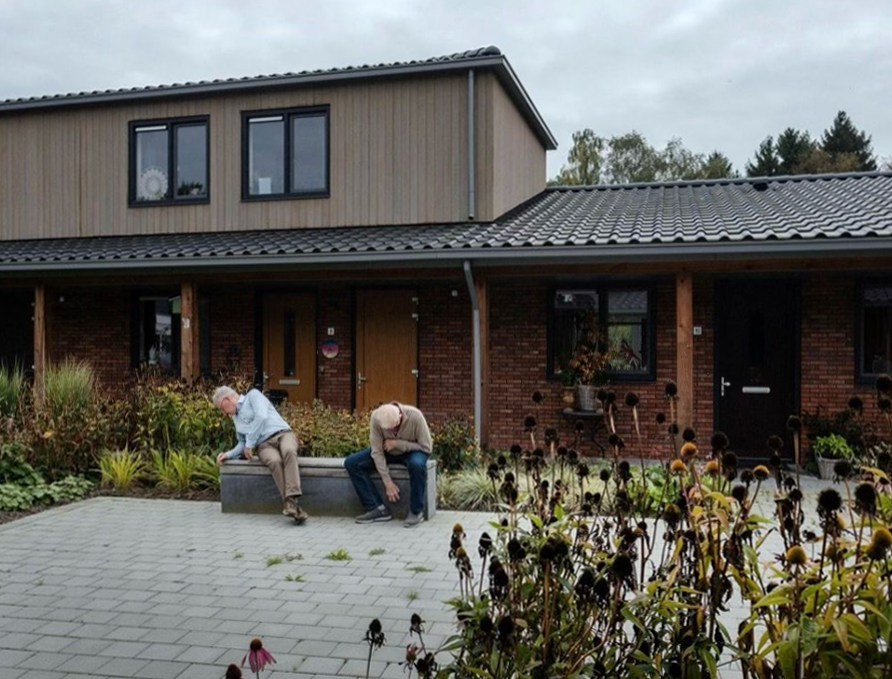
With his vision and his designs, Hartzema resists the business like, one-sided view that he encounters in all the policy bubbles and systems he has to deal with. The world of construction and spatial planning is mainly concerned with homes and forgets to think about schools, parks, healthcare. With what holds things together and what society we are building. The world of healthcare is so institutionalized and so rigid and complicated, with so many rules and frameworks, requirements and regulations, that the basic question of the quality of life and housing in many cases fades into the background. ‘This creates buildings where everything is right according to the rules but where humanity is lacking,’ he says. Yet he recently managed to bring the two worlds together: in Papendrecht he designed the so called caring neighbourhood Kraaihoek with 78 family homes and 59 life-long apartments for people with care needs. Housing corporation Woonkracht10 and developer Heijmans consciously chose a neighbourhood in which young and old live together and in which the residents together form a ‘caring neighbourhood’ through a smart design and design. People know each other, help each other and look out for each other, that’s the approach.
Hartzema was responsible for the design that makes interconnectedness and caring possible and that connects care and living. The district is designed for pedestrians so that people meet each other and so that residents who are less mobile also have plenty of freedom of movement. There are convenient driving routes for night nurses and there is a place where home care can always park easily. ‘That saves a lot of lost time and therefore money,’ says Hartzema. Moreover, the care homes and the non-care homes are located on the same street. ‘With the sun and a bench in front of the door. So that you don’t immediately end up in the central hall with the smell of overcooked vegetables.’
They found each other in ‘humane values,’ says Hartzema about the collaboration with Woonkracht10 and Heijmans. Before they got to work, they jointly made a manifesto with starting points, a list with mainly ‘human aspects’. This approach is special, he knows, while it should be self-evident: ‘Designing on the basis of social issues has traditionally been an excellence that we have in the Netherlands. But we have completely lost that.’
He cherishes the cooperation where that intention is present, such as now in the Holy Southwest district in Vlaardingen. There is a huge overrepresentation of healthcare institutions, all of which are very inward-looking. While in the aging neighbourhood with a relatively vulnerable population, there is a great need for care. How do you connect the world of care with the living environment of the residents? Is it possible to embed care in the neighbourhood in the same way as schools and sports clubs? Hartzema: ‘For that, we need a revolution from the bottom up and from the top down. By making the most ordinary things important and by someone who understands it. And we need examples: a new image and a new story.’
Excerpts from: Floor Milikowski in De Groene Amsterdammer, 14 October 2026
Image: Merlin Daleman